Texans-Bills Week 1 Recap: Plenty to Build On Despite the Loss

Before diving into this in-depth analysis, make sure to subscribe to the Houston Stressans newsletter for exclusive Texans content, film breakdowns, and insider analysis straight to your inbox! Don't miss out on the latest updates—sign up today
It feels a little weird to say this after a loss, but I came away from the Texans’ Week 1 game against Buffalo feeling pretty encouraged overall.
Obviously, they had every opportunity to win the game. There were several plays that could have changed the outcome, and the Texans ultimately drove inside Buffalo’s 10-yard line with a chance to take the lead late. Finishing that drive would have completely changed the conversation coming out of Week 1.
Still, when I look at what I was most concerned about entering the season, a lot of it centered around the offense. Could the offensive line actually be better? Could the Texans establish a legitimate run game? Would the offense be able to handle short yardage? What would Year 2 under Nick Caley look like? And, of course, how would C.J. Stroud look after everything that has been said about him this offseason?
Meanwhile, the defense was the side I had significantly fewer questions about. One rough game against Josh Allen and a really good Bills offense doesn't suddenly change what we've seen from DeMeco Ryans' defense or the amount of proven talent Houston has on that side of the ball.
So if the Texans were going to lose this game regardless, I would much rather it happen this way than come away wondering whether the same offensive problems from last season were still there.
The offense gave me plenty to like
The biggest positive for me was probably how functional the offense looked as a whole.
It wasn't perfect, and one game certainly isn't enough to declare all of last year's problems fixed, but this looked much closer to the offense I hoped we would see after another offseason under Caley.
The run game was probably the most noticeable difference. Houston wasn't just calling runs to stay balanced. The Texans were getting legitimate movement up front, creating opportunities for the backs and, most importantly, showing they could run the ball when Buffalo knew there was a good chance it was coming.
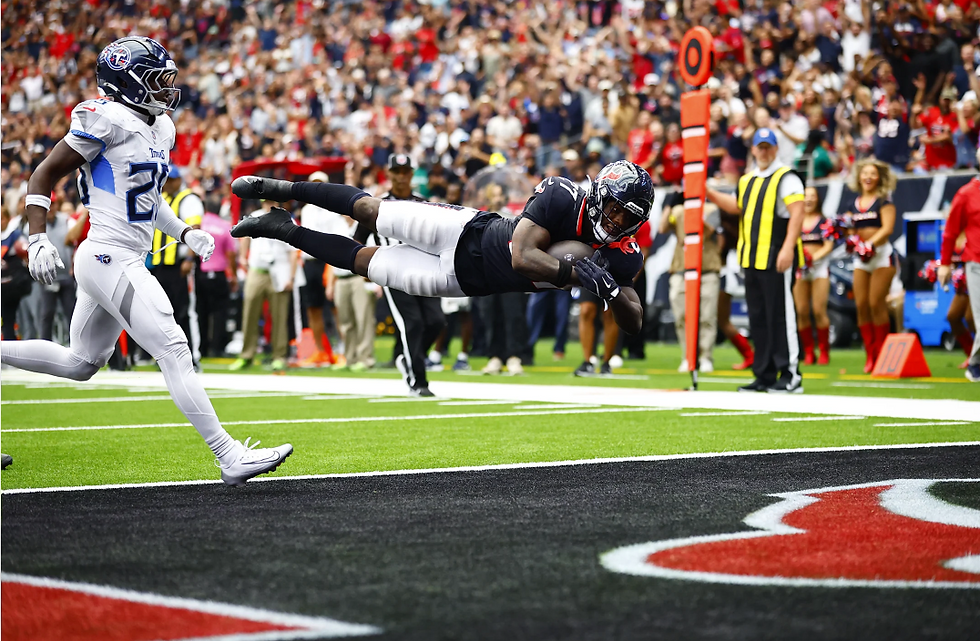
David Montgomery already looks like a really important addition. There were runs where everything wasn't blocked perfectly and he still found a way to get something out of them, including around the goal line. That's something I talked about quite a bit this offseason. Improving the offensive line matters, but pairing that improvement with a back who can occasionally make the blocking right when it isn't perfect can make a huge difference.
Woody Marks also ran well, and Stroud specifically praised both backs and the offensive line afterward. He talked about Houston getting a hat on a hat and the backs being able to make safeties and corners miss once they got through the first level.
The short-yardage success was probably just as encouraging. Houston converted multiple fourth downs, including one on its own side of the field, and I thought DeMeco was noticeably more aggressive because he seemingly trusted what he was seeing from the offense.
We've criticized some of his conservative decisions in the past, but I think there's some context worth considering there too. It's a lot easier to go for fourth-and-short when you trust your offensive line and run game to actually get the yard. DeMeco essentially talked about that after the game, saying the way the offensive line was playing made some of those decisions easier.
If the offensive line and run game continue to give him that confidence, I would expect some of the aggressiveness we saw against Buffalo to continue.
I also liked Caley's game overall. There was a good mix of the run and pass, play action, motion and some different wrinkles. The offense seemed particularly comfortable when it went tempo, which continues to be something I'd like to see Houston experiment with outside of obvious two-minute situations.
That doesn't mean abandoning the heavier personnel packages or the run game that worked. I just think there's an opportunity to marry the two. If Houston can establish the run from heavier personnel and then occasionally spread a defense out, get Jaylin Noel on the field and let Stroud operate with tempo, that could give defenses another problem to prepare for.
I thought Stroud played well overall
The two fumbles will understandably be part of the conversation, but I thought Stroud played a good game overall.
The first fumble is one he has to own. I didn't have much of an issue with the decision to scramble because nothing appeared to be available and he had space in front of him, but once he takes off he has to protect the football. Buffalo ended up getting three points off the turnover, which obviously matters in a close game.
I view the final play differently.
The Texans had driven inside Buffalo's 10 with a chance to win before taking a sack. With no timeouts and the clock running, they were in a really difficult situation on the next snap. Buffalo rushed three, Greg Rousseau got through Trent Brown almost immediately and Stroud really didn't have the option of simply taking another sack and living for the next play because there probably wasn't going to be one.
I'm sure there are things Stroud could have done differently on the play, and I'm not interested in absolving him of every negative result. But I also don't think looking at the box score, seeing "fumble" and putting the ending entirely on the quarterback tells you much about what actually happened.
More importantly, I thought he looked comfortable for most of the game. The offense moved the ball, he handled the operation well and Houston was nine yards away from potentially winning the game against a Buffalo defense that changed its approach as the game went on.
That last part was interesting to me because Buffalo initially seemed intent on heating Stroud up. Houston had answers for it, particularly with the quick game, and Jim Leonhard eventually backed off some of that pressure and played more coverage.
I don't think Buffalo's adjustment suddenly shut the offense down, but it seemed to give them some marginal wins by taking away some of the quicker answers and making Stroud hold the ball longer. That's part of the chess match that I'll be interested to see continue throughout the season.
Buffalo's offensive plan deserves a lot of credit
I came into this game expecting Houston's defensive line to be one of its biggest advantages because of what happened the last time these teams played. Instead of simply running it back and hoping for a different result, Joe Brady had a really good plan for dealing with Houston's pass rush.
Buffalo leaned heavily into bigger personnel packages and used tight ends, running backs and even receivers to help with Will Anderson Jr. and Danielle Hunter. Brady talked afterward about it being "all hands on deck" when it came to handling Houston's edges, including DJ Moore helping chip late in the game.
That accomplished a couple of things. It gave Allen more time, but the heavier personnel also helped Buffalo create some of the matchups it wanted for Dalton Kincaid.
I thought Kincaid was one of the biggest differences from the previous matchup.
Houston has had some issues with high-end receiving tight ends before, and Buffalo was able to get him matched against safeties and linebackers while still having enough bodies available to help protect Allen.
There aren't a ton of teams with a tight end capable of stressing a defense the way Kincaid can, so I wouldn't assume everyone can simply copy Buffalo's game plan and get the same results. But teams are obviously going to study this tape, and it'll be interesting to see how Houston handles similar personnel groupings going forward.
The protection plan also put more pressure on Houston's interior defensive linemen to win. If Buffalo is devoting extra attention to Anderson and Hunter and Houston is still only rushing four, ideally somebody inside takes advantage of those one-on-one opportunities. That didn't happen consistently enough.
It's one reason I'm curious whether we eventually see more creative combinations with Jadeveon Clowney, including kicking him inside or moving Anderson around. Clowney made an impact in relatively limited snaps, and Houston has some different options available that we didn't see much of Sunday.
I would have liked to see Houston adjust more
This was probably my biggest criticism of the defensive game plan.
I understood the initial approach. Houston didn't want to blitz Allen heavily, give him easy answers and allow him to escape the pocket against fewer defenders in coverage.
The idea seemed to be to rush four, keep bodies on the back end and make him hold the football long enough for Anderson and Hunter to eventually get there.
The problem was Buffalo found a pretty effective answer for it with all of the protection help.
Once Allen was getting time anyway and Buffalo was already creating explosive plays, I thought Houston could have mixed in more pressure. Not necessarily all-out blitzes, because Allen can obviously punish those too, but enough to change the picture and make Buffalo account for another potential rusher.
Houston blitzed very little, and Allen wasn't particularly productive on the few dropbacks where they did bring extra pressure.
Maybe DeMeco simply trusted his normal approach for too long. It's also possible there are things he didn't want to show in Week 1, especially against a team Houston could potentially see again. There's obviously no way for me to know that from the outside.
It did make me think about the Browns games in 2023, though. Houston played Cleveland late in the regular season with a fairly straightforward approach, including not having Stingley follow Amari Cooper. When they saw Cleveland again in the playoffs a few weeks later, the Texans were much more aggressive and showed some things they hadn't shown in the first matchup.
I'm not saying that's definitely what DeMeco was doing here, but it's something I'll keep in mind if these teams happen to meet again.
Not every explosive was necessarily bad defense
Houston's secondary didn't have a good day overall, and there were certainly individual plays guys would like back. Kamari Lassiter had an unusually rough game by the standard he's established, and Reed Blankenship found himself in some difficult matchups.
At the same time, I think there's a tendency after a game like this to watch every completion and assume somebody must have completely blown the coverage.
The deep Allen-to-Kincaid completion backed up near Buffalo's own goal line is a good example. Stingley was in really good position on the corner route, Anderson was closing on Allen and Allen somehow threw the ball away from his momentum to Kincaid's back shoulder. Kincaid then made an incredible adjustment to finish the play.
There are coverage details you can pick apart, including Calen Bullock reacting to Allen's pump fake, but sometimes a great quarterback and a great receiving tight end are going to make a ridiculous play.
The bigger issue to me was how many of those opportunities Buffalo converted.
Some were defensive mistakes. Some were contested balls where Houston had an opportunity to make the play. Others were just really good throws and catches. It felt like almost every high-variance play went Buffalo's way, whether it ended with a completion or a defensive pass interference penalty.
That doesn't make it luck. Buffalo deserves credit for being willing to attack those matchups and for actually making the plays.
Houston simply didn't make enough of its own.
The potential interception late from Lassiter is probably the easiest example. If he comes down with that ball, there's a good chance the entire conversation surrounding this game looks different. Instead, Buffalo survived the mistake and eventually won.
That's also why I'm hesitant to draw massive conclusions about either quarterback from the ending. If Lassiter catches that ball, Allen doesn't suddenly become a bad quarterback who "choked." Likewise, Stroud doesn't suddenly become a bad quarterback because the final drive ended with Rousseau beating the protection and forcing a fumble.
Games between good teams can turn on a handful of plays like that.
Special teams lost some hidden yardage
Special teams was another area that I thought quietly hurt Houston, particularly in the field-position battle. The kickoff and kick return units both left some hidden yardage on the field. Buffalo had more success creating return yardage, while Houston didn't get much going the other way.
I thought the same applied to the punt return game. Jaylin Noel had a couple opportunities where there appeared to be more yardage available than Houston ultimately got, so that's another area where I'd like to see improvement as he gets more comfortable in that role.
The actual kicking and punting were positives. Ka'imi Fairbairn drilled a 58-yard field goal, and rookie punter Kai Kroeger had a really encouraging debut. Kroeger pinned Buffalo at the 4-yard line twice, which is exactly what you want when you're trying to help your defense win the field-position battle.
None of these things individually decided the game, but in a matchup this close, that hidden yardage adds up. Houston was generally solid when actually kicking the football. The bigger opportunity for improvement is everything happening around it in the return and coverage phases.
Why I'm still encouraged
The defense obviously has plenty to correct, but I'm much less worried about that side of the ball because we already have a pretty large sample of what this group can be.
I don't suddenly think Lassiter forgot how to cover. I don't think Stingley is suddenly a concern. I'm certainly not worried about Anderson and Hunter because Buffalo built a significant portion of its offensive plan around preventing those two from wrecking the game.
The offense was where I needed to see something different, and for at least one week, I did.
The offensive line looked improved. Houston ran the ball effectively. Montgomery gave them a physical presence they've needed. They converted in short yardage. Caley was able to call a more balanced game. DeMeco seemingly trusted the offense enough to be aggressive on fourth down, and Stroud helped drive the Texans inside Buffalo's 10 with an opportunity to win the game late.
None of that guarantees this offense has suddenly arrived. Buffalo is also adjusting to a new defensive coordinator, it's Week 1 and we're dealing with a one-game sample.
But those are encouraging developments because they're directly related to many of the things that held Houston back last season.
The Texans still lost a game they had a legitimate chance to win, so there are obviously no moral victories here. But if the offense can build on what it showed against Buffalo while the defense gets back closer to the level we've come to expect, I feel pretty good about where this team can go from here.
So I'm definitely Stressan after starting 0-1.
Just not nearly as much as I expected to be.



.png)
Comments