Protect the Window: How the Texans Could Approach the 2026 NFL Draft Top 100 Analysis
With C.J. Stroud and Will Anderson Jr. still on rookie contracts and the roster firmly in contention mode, this draft isn’t about rebuilding; it’s about closing the gap. Nick Caserio enters the offseason with significant financial flexibility and four top-100 picks, positioning Houston to be aggressive without being reckless. Thanks to additional draft capital from prior trades (Laremy Tunsil + Trading down last draft), the Texans have the ammunition to maneuver up or down the board if they choose. In a championship window defined by value and impact, Caserio must now turn flexibility into contributors who can raise both the floor and ceiling of this team heading into 2026.
So what should the draft strategy be?
There is a growing narrative nationally that C.J. Stroud regressed in his second season. But within Houston, the issue feels more structural than individual. Injuries and inconsistency along the offensive line, a stagnant run game, and uneven play design placed more strain on the quarterback than ideal. Stroud’s tools haven’t diminished; the environment around him has fluctuated.
If that belief is correct, then the draft must be about stabilizing the infrastructure. Whether that means reinforcing the exterior offensive line, adding a difference-maker in the run game, or improving interior protection, Houston’s approach should focus on raising the floor of the offense without sacrificing the defensive identity DeMeco Ryans has built.
This isn’t about chasing headlines. It’s about insulating your franchise quarterback while maximizing a roster that’s already close.
Philosophy defines direction, but execution defines outcome. If Houston truly prioritizes raising the floor around C.J. Stroud while maintaining defensive flexibility, the early rounds should reflect that emphasis. Here are several prospects who align with that vision.
1. Monroe Freeling - LT (Georgia)

Freeling is a 6’7”, 315-pound left tackle with prototypical NFL size and high-end pass protection traits. His fluid feet and heavy hands allow him to mirror rushers effectively, and he consistently flashed against top-tier SEC competition. That said, his anchor strength and technical consistency still require refinement.
As a true junior, Freeling brings developmental upside, but his frame and movement skills suggest long-term starter potential. While he played left tackle at Georgia, projecting him to right tackle early in his NFL career may make the most sense for Houston. That transition would complement last year’s second-round pick, Aireontae Ersery, who showed enough promise as a rookie to remain at left tackle.
Freeling is widely viewed as a late first- to early second-round prospect (Daniel Jeremiah's 25th ranked prospect, PFF's 34th). With true tackle size and athletic traits at a premium, there’s a realistic chance he’s off the board before Houston selects at No. 28.
For the Texans, the appeal is clear. Adding a high-upside tackle would stabilize the edge, improve pass protection for C.J. Stroud, and reinforce the franchise’s commitment to preserving its quarterback window. It may not be the splashiest selection, but it would be one of the most aligned with the team’s long-term trajectory.
Freeling’s tape is some of the most impressive in the country from a pass-protection standpoint. The areas where he needs to grow (particularly in the run game and anchoring against power) are coachable. The movement skills, length, and hand usage are not. If he’s on the board at No. 28, he would be my selection. I would take him over comparable tackle prospects such as Caleb Lomu or Kadyn Proctor, because I believe his ceiling as a long-term pass protector best aligns with preserving C.J. Stroud’s prime years.
2. Blake Miller - RT (Clemson)

Blake Miller brings a different profile than Freeling. The 6'6 315LB Right Tackle for the Tigers was a dependable option throughout college, and he may even project to be a guard in the NFL (Versatile option). While he doesn’t possess quite the same rare length or natural fluidity, Miller offers polish, experience, and technical stability. A multi-year starter at Clemson, he’s faced high-level ACC competition and has shown steady growth each season.
What stands out on tape is his balance and hand placement. Miller plays under control, rarely panics against speed, and shows better early-down run-game consistency than many tackles in this range. He may not overwhelm defenders with elite traits, but he wins with positioning and functional strength.
For Houston, Miller would represent the “safer” projection. He likely profiles as a right tackle early, with the versatility to slide if needed. If the Texans prioritize floor over pure upside, Miller could step in and compete immediately while offering long-term reliability.
Unlike Freeling, who is viewed as a late first to early second-round talent, Miller is more commonly projected in the second-round range; however, he has began to climb up draft boards throughout the draft process (Daniel Jeremiah's 24th ranked overall prospect, PFF's 38th), and I expect him to kill the combine. That could make him a realistic target at No. 28 if Houston trades back, or a strong option with their second pick.
Personally, if the board falls in a way where elite upside tackles are gone, Miller would be an extremely defensible selection. He may not have the ceiling of a Freeling, but he offers the type of steadiness that can quietly solidify an offensive line for years, and that has real value when protecting a franchise quarterback. If it was between Freeling and Miller, I'd go Freeling, but I love the idea of Blake Miller in Houston as he has been my draft crush throughout this process alongside Pat Coogan.
3. Peter Woods DT - (Clemson)

Peter Woods is one of the most disruptive interior defenders in college football. At around 6’3”, 315 pounds, he combines low-pad leverage, explosive first-step quickness, and violent hands to consistently collapse the pocket from the inside.
What makes Woods intriguing isn’t just his ability to anchor against the run; it’s his interior pass-rush upside. In today’s NFL, pressure up the middle is often more damaging than edge rush alone, and Woods flashes the ability to win quickly in one-on-one situations.
That would pair beautifully with Will Anderson Jr. & Danielle Hunter off the edge, creating a more complete and balanced pass rush.
For Houston, this would represent a “defense-first” investment. While the offense may need stabilization, adding a disruptive 3-technique could elevate DeMeco Ryans’ unit from dominant to potentially generational. If the Texans believe their offensive issues are more about health and cohesion than talent, Woods becomes an extremely attractive option at No. 28.
He is generally viewed as a late first-round prospect with potential to rise depending on pre-draft evaluations. If he’s available when Houston is on the clock, the value could be difficult to ignore.
What makes the most sense?
If both the offensive tackles and Peter Woods are on the board at No. 28, the decision becomes philosophical. Protecting C.J. Stroud is critical — but so is dictating games defensively in January.
While Monroe Freeling may offer long-term stability on the edge, Woods provides something harder to find: interior disruption with true difference-making upside. His ability to collapse the pocket would complement Will Anderson Jr. and force opposing quarterbacks to deal with pressure from all angles.
For me, that swings the decision.
Houston’s defensive identity under DeMeco Ryans is already a strength. Adding Woods doesn’t just maintain that edge; it amplifies it. If the Texans believe their offensive inconsistencies are more about health and cohesion than personnel limitations, doubling down on defensive dominance may offer the higher ceiling play.
At No. 28, Peter Woods would be my selection.
After investing in the defensive front at No. 28, the Texans would enter pick No. 38 with flexibility rather than desperation. With interior disruption added in Peter Woods, the focus could now shift to reinforcing the offense and restoring balance to the roster.
1. Max Iheanachor RT - (Arizona State)
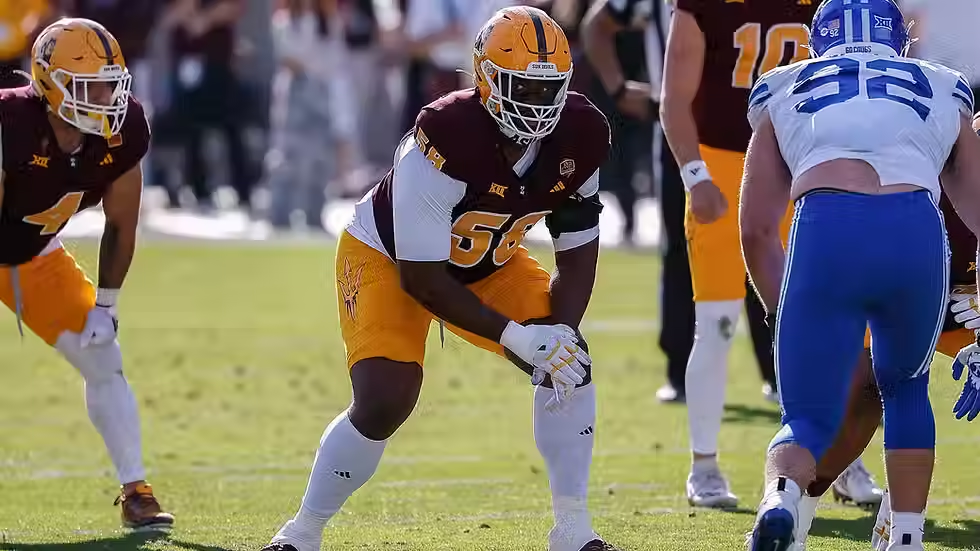
Max Iheanachor’s most intriguing trait isn’t his traditional tackle size; it’s his footwork. Being one of the most unique prospects in this class, Iheanachor moves with a natural fluidity that simply can’t be coached. His kick slide is smooth and controlled, he mirrors speed rushers with light feet, and he rarely looks rushed when redirecting inside counters. That kind of movement skill is unteachable, it’s instinctive.
When evaluating offensive tackles, foot speed and balance are often the hardest traits to develop at the next level. Strength can be added. Hand placement can be cleaned up. Technique can be drilled. But natural lateral quickness and body control are innate, and Iheanachor shows both.
There are areas that still need polish. His hands can get wide, and his overall play strength must continue developing to handle elite NFL power. But the foundational mechanics in his lower body, the ability to stay square, absorb contact, and recover when beaten initially; suggest long-term starting potential.
For Houston at No. 38, this would be a traits pick rooted in projection. After investing in Peter Woods in the first round, selecting Iheanachor would signal a commitment to developing high-ceiling protection for C.J. Stroud rather than settling for limited upside. If Monroe Freeling or Blake Miller unexpectedly fall, that’s the easy value. But assuming they’re off the board, Iheanachor’s movement skills make him the swing worth taking.
2. Chase Bisontis OG - (Texas A&M)

Chase Bisontis offers a different profile than the tackle prospects discussed earlier. A 6'6 330LB Guard that is one of the best pass blockers in this class. Where a player like Iheanachor wins with length and fluid footwork, Bisontis wins with leverage, power, and interior physicality. At his best, he creates movement in the run game and plays with the kind of strength that establishes tone up front.
For Houston, the appeal becomes even clearer when considering roster flexibility. With Tytus Howard capable of sliding back out to right tackle, a position he has experience playing, drafting Bisontis would allow the Texans to solidify the interior while maximizing Howard’s versatility. That alignment could stabilize both guard and tackle spots without forcing a rookie into immediate edge responsibilities.
After selecting Peter Woods at No. 28, adding Bisontis at 38 would signal a commitment to raising the offensive floor. Rather than swinging purely for upside, this would be about reinforcing structure, improving the run game, reducing interior pressure on C.J. Stroud, and creating lineup flexibility across the front.
If Iheanachor represents ceiling, Bisontis represents stability. And in a competitive window, stability along the interior can be just as valuable as flash on the edge.
What makes the most sense?
If Peter Woods is the selection @ No. 28, at 38, the real conversation comes down to two very different offensive line profiles: Chase Bisontis and Max Iheanachor.
Iheanachor offers the higher ceiling. His footwork is natural and fluid, the kind of movement skill you simply can’t teach. With true tackle size and pass-protection upside, he represents the long-term swing; a potential right tackle of the future with developmental runway.
Bisontis, on the other hand, brings something more immediate.
He plays with interior power, leverage, and a physical edge that Houston’s run game lacked at times last season. His anchor strength and ability to generate push inside would directly address one of the offense’s biggest inconsistencies. While he may not carry the same athletic ceiling as Iheanachor, his floor is higher, and his path to early impact is clearer.
That’s why, in this projection, I’m siding with Bisontis.
After selecting Peter Woods at 28 to raise the defensive ceiling, the smarter move at 38 is to stabilize the offense. With Tytus Howard capable of playing right tackle, drafting Bisontis allows Houston to reinforce the interior without forcing a rookie to handle edge duties immediately. In this window, raising the floor matters.
For me, at No. 38, Chase Bisontis would be my pick.
After addressing the defensive front at 28 and reinforcing the offensive interior at 38, Houston enters pick No. 59 in a position of strength. With immediate needs stabilized, this selection can focus on adding dynamic value rather than plugging holes.
1. Max Klare TE - (Ohio State)

Max Klare isn’t just a receiving mismatch; he’s a legitimate two-way tight end. At Ohio State, he has shown willingness and functional strength as an inline blocker, engaging defensive ends with proper hand placement and solid leverage. He doesn’t shy away from contact, and his pad level allows him to generate movement in combo blocks and seal edges effectively in outside-zone concepts. He also has prototypical size to line up on the inline (Outside the Tackle) @ 6'5 243LB.
What stands out most is his balance at the point of attack. Klare keeps his base wide, sustains through contact, and understands angles; especially when working across a defender’s frame on split-zone or motion concepts. While he may not be a mauling Y-tight end in the traditional sense, he’s far from a liability. He can stay on the field in 11 or 12 personnel without telegraphing run or pass. That matters for Houston.
After drafting Peter Woods and Chase Bisontis, the Texans would already be reinforcing physicality in the trenches. Klare fits that identity while adding versatility. He can block well enough to support the run game and still detach into the slot to create mismatches. That dual-threat ability keeps defenses honest and expands play-calling flexibility for Nick Caley.
At 59, Klare would represent balance; a player who improves the offense structurally without sacrificing explosiveness. He doesn’t just add another target for C.J. Stroud; he makes the entire offensive operation more multiple.
2. Jadarian Price RB - (Notre Dame)

Jadarian Price brings something Houston’s offense has lacked at times: instant acceleration. His ability to press the line, plant once, and explode vertically makes him dangerous in zone-based schemes. He doesn’t dance in the backfield; he commits and attacks creases decisively.
What separates Price is his second-level speed. Once he clears the line of scrimmage, he can flip field position quickly. That type of burst forces safeties to respect the run game, which directly benefits play-action; an area where C.J. Stroud thrives.
He also shows comfort catching passes out of the backfield, giving Houston flexibility in screen concepts and check-down situations. With Bisontis potentially reinforcing the interior offensive line, Price’s one-cut style would pair naturally with improved interior push.
At 59, this would be an offensive ceiling pick. It’s not just about adding another running back; it’s about adding game-breaking ability that can punish light boxes and prevent defenses from sitting in two-high shells all game.
3. Josiah Trotter LB - (Missouri)

Josiah Trotter is one of my favorite players in this entire draft class. He plays linebacker the way you want it played: decisive, physical, and instinctive.
At Missouri, Trotter consistently showed high-level diagnostic ability. He reads run concepts quickly, trusts his keys, and triggers downhill without wasted motion. His tackling is controlled and reliable, and he rarely overruns plays. That efficiency matters in a defense built on structure and discipline.
With EJ Speed entering free agency, this pick becomes more than just value; it becomes proactive roster planning. If Speed departs, Houston would need a linebacker capable of stepping into meaningful snaps without a steep learning curve. Trotter’s processing speed and football IQ make him a natural fit in DeMeco Ryans’ system.
He’s not just a downhill thumper either. In coverage, Trotter understands spacing and communicates well. He won’t wow with elite sideline-to-sideline speed, but he plays fast because he diagnoses fast. He also brings value as a situational blitzer, timing interior gaps effectively.
At 59, this would be an identity pick. After adding Peter Woods at 28, selecting Trotter would double down on building a front seven that dictates tempo. And personally, if he’s on the board here, it would be hard for me to pass; especially if the Texans anticipate turnover at linebacker.
What makes the most sense?
If Peter Woods is the selection at No. 28 and Chase Bisontis is the choice at 38, then at 59 the real conversation shifts toward offensive versatility versus explosive upside: Max Klare or Jadarian Price, with Josiah Trotter firmly in the mix as well.
Price offers the most immediate explosiveness. His burst through the line of scrimmage and ability to flip the field with one cut would inject juice into an offense that at times lacked a true home-run threat. He pairs naturally with an improved interior offensive line and would stress defenses horizontally and vertically. If the goal is adding pure speed, Price is the swing.
Trotter, meanwhile, represents defensive reinforcement. With EJ Speed entering free agency, linebacker depth could quickly become a priority. Trotter’s instincts, downhill trigger, and football IQ make him a natural schematic fit. He would keep the defensive identity strong and maintain front-seven depth in a system built on discipline and communication.
Klare, on the other hand, brings balance.
He gives Houston a true two-way tight end; someone who can block inline, sustain in the run game, and still detach as a receiving threat. His ability to stay on the field in multiple personnel packages without telegraphing play calls adds structural flexibility to the offense. For a quarterback like C.J. Stroud, who thrives on timing and spacing, a tight end who understands leverage and coverage voids is invaluable.
That’s why, in this projection, I’m siding with Klare.
After addressing the defensive front at 28 and stabilizing the offensive interior at 38, the smarter move at 59 is expanding the offense’s versatility. Klare strengthens the run game, improves personnel flexibility, and adds another reliable target without sacrificing physical identity.
If either Iheanachor or Bisontis were to unexpectedly fall, that would immediately become the selection. Offensive line value at that range is too important to pass up.
But assuming the board holds, for me, at No. 59, Max Klare would be the pick.
After reinforcing the defensive front at 28, stabilizing the offensive interior at 38, and expanding offensive versatility at 59, Houston enters pick No. 69 without urgency. The major structural needs have been addressed. This selection becomes about depth, long-term value, and continuing to shape the identity of the roster.
At 69, the real conversation comes down to three different paths: secondary versatility, offensive explosiveness, or linebacker depth.
1. Kamari Ramsey S - (USC)

Ramsey brings modern defensive versatility. At USC, he has shown the ability to rotate from single-high looks into the box, match slot receivers in sub-packages, and close downhill against the run. His range is controlled rather than reckless; he takes efficient angles and finishes plays with physicality.
What stands out most is his spatial awareness. Ramsey understands route combinations and anticipates throwing windows rather than reacting late. In a division and conference filled with spread-heavy offenses, that kind of processing is valuable. He may not profile as a pure ball-hawking free safety, but he offers alignment flexibility and scheme disguise potential.
If Houston wants to continue building defensive multiplicity under DeMeco Ryans, Ramsey fits seamlessly.
2. Emmett Johnson RB - (Nebraska)

Johnson brings suddenness. His ability to press the line and explode through a crease gives him big-play potential every time he touches the ball. He runs with urgency and shows natural acceleration through the second level, which forces safeties to account for him early.
He also flashes soft hands out of the backfield and can contribute in space on screens or angle routes. While he isn’t a bruising power back, he pairs well with a strengthened interior line; particularly if Bisontis helps generate push inside.
At 69, Johnson would be about injecting pace into the offense. After building structure up front and adding versatility with Klare, this would be the speed component.
3. Jacob Rodriguez LB - (Texas Tech)

Rodriguez is a high-IQ defender who consistently finds the football. At Texas Tech, he showed advanced diagnostic ability against both gap and zone concepts. He trusts his reads, flows efficiently to the ball, and rarely wastes steps.
What makes Rodriguez appealing in this range is reliability. He’s a secure tackler and communicates well pre-snap. While he may not possess elite sideline-to-sideline athleticism, his instincts allow him to play faster than he tests. He also brings blitz value, timing interior rush lanes effectively.
If Houston anticipates linebacker turnover (or want to get younger), especially with EJ Speed entering free agency, Rodriguez offers rotational depth with upside to grow into a larger role.
What makes the most sense?
After reinforcing the defensive front at 28, stabilizing the offensive interior at 38, and expanding versatility at 59, Houston enters No. 69 in a position to add dynamic value rather than fill a glaring hole.
At 69, the conversation comes down to secondary flexibility, linebacker depth, or offensive speed: Kamari Ramsey, Jacob Rodriguez, or Emmett Johnson.
Ramsey offers defensive versatility. His ability to rotate between deep coverage and box responsibility would strengthen sub-packages and provide alignment flexibility in DeMeco Ryans’ system. He’s controlled, physical, and reliable; the kind of depth piece that keeps a defense stable late in the season.
Rodriguez brings instinctive linebacker play. With EJ Speed entering free agency, adding a downhill, diagnostic defender would be proactive roster management. He processes quickly and plays with discipline, even if he lacks elite athletic traits.
Johnson, on the other hand, brings juice.
He accelerates through creases with urgency and has the second-level speed to flip field position instantly. His one-cut ability pairs naturally with improved interior push from Bisontis, and his receiving ability adds another layer to the offense. After adding structural pieces early in the draft, Johnson injects pace and unpredictability.
That’s why, in this projection, I’m siding with Johnson.
Houston has already reinforced the trenches and added versatility. Now it’s time to add explosiveness. In a conference built on scoring, chunk plays matter, and Johnson provides that threat.
For me, at No. 69, Emmett Johnson would be the pick.
The goal of this draft isn’t to chase headlines; it’s to build sustainably around a roster that’s already close. Peter Woods raises the defensive ceiling. Chase Bisontis stabilizes the offensive interior. Max Klare expands schematic flexibility. Emmett Johnson injects the explosiveness that can tilt games in January.
This approach doesn’t overreact to short-term narratives. It reinforces the trenches, protects the quarterback, and adds speed without sacrificing identity. With C.J. Stroud still on his rookie contract and the competitive window open, the Texans don’t need to reinvent themselves, they need to sharpen what already works.
If the board falls this way, Houston walks away from the top 100 with balance, upside, and long-term flexibility.
And in this window, that’s exactly what matters.
All in all, the Texans are in a very flexible spot to approach the offseason with to enhance their Super Bowl contending roster to hopefully finally make it to the final 4 of the postseason. I hope you all enjoyed this read, and let me know y'alls thoughts!


.png)
Comments